



Picture this: a customer is opening a new financial account or signing up on the mobile application from their phone.
They want the process to complete faster. Your compliance team needs confidence that the person is real. Your fraud team is watching for synthetic identities, SIM swaps, account takeover, and AI-enabled attacks that are getting harder to spot
➡️ That tension is exactly where fintech identity verification is heading.
If you work in financial services, identity verification is already central to
- Know Your Customer (KYC)
- Anti-Money Laundering (AML) compliance
- Fraud prevention
- and customer trust which is changing is the pace.
Remote onboarding is now standard, AI-enabled fraud is becoming more convincing, and customers expect security that does not slow them down.
For fintech teams, the question is no longer whether to modernize identity verification. It is about building a stack strong enough to handle today’s threats without damaging the customer experience.
What digital identity verification really means
Digital identity verification is the process of confirming that a user is who they claim to be through digital means, often without any in-person interaction.
In practice, that matters at three critical moments:
- onboarding a new customer
- authorizing a higher-risk transaction
- and protecting account access when something looks unusual.
At its core, this is about trust.
A financial product only works when the institution can confidently link a real person to an account, payment, or action.
But trust is no longer built through a single document upload or a single password check. It is built through a set of signals that work together:
- identity documents
- biometrics
- device context
- phone-number intelligence
- behavioral cues
- and risk scoring.
Why the old model is under pressure
Identity verification has moved from physical ID checks to database matching, passwords, one-time passwords (OTPs), and smartphone-based biometrics.
Each step improved convenience, but each also introduced new weaknesses. Passwords remain common, but they are difficult for users to manage and easy for attackers to exploit at scale.
Recent market analysis from Juniper Research says global spending on digital identity verification is expected to grow 55% between 2026 and 2030, from just under $19 billion in 2026, driven by tighter regulation, interoperable systems, and more unified platforms.
OTPs are helpful as a second factor, but SMS-based OTPs still carry well-known risks, especially phishing and SIM swap attacks. As pointed out by Deloitte, biometric methods such as fingerprint and facial recognition can improve convenience and security, but they are not invulnerable.
Facial systems now need robust liveness detection because deepfakes, face swaps, and injected virtual camera feeds are improving quickly.
Voice recognition has also become weaker as a standalone factor because high-quality voice cloning can require very little source audio.
Behavioral biometrics add another layer by monitoring how users type, swipe, and navigate over time, helping detect account takeover during a session rather than only at login.
The shift toward layered verification
The most effective fintech strategies no longer rely on a single verification method.
Instead of asking, “Which method replaces passwords?” leading teams are asking, “Which signals should we combine for this user, this action, and this level of risk?”
A routine login from a known device should not feel the same as a password reset from a new device after a recent SIM change. A new account opening may need
- document verification
- biometric matching
- device intelligence
- and database checks.
A suspicious transaction may require step-up authentication and behavioral analysis. The decision should adapt to the risk.
That is why orchestration matters.
LexisNexis Risk Solutions, Experian, and Thales were identified by Juniper Research as top vendors in 2026, reflecting a broader shift away from isolated point solutions toward platforms that combine document, biometric, behavioral, device, and data signals into a more complete risk decision.
The missing layer: network-level verification
Here is where many identity stacks still have a gap.
They focus almost entirely on the application layer: what the user knows, has, presents, or clicks.
But mobile networks can provide useful real-time signals about phone numbers, SIM status, and device context.
Standardized APIs from GSMA Open Gateway and CAMARA are making these network signals more accessible to developers and financial applications.
This is where Shabodi NetAware Operator Platform is positioned.
NetAware helps expose operators’ network capabilities through standardized APIs, enabling financial applications to use mobile network intelligence directly in verification and fraud workflows.
A strong example is silent number verification. Instead of sending a code via SMS and asking the user to type it back in, number verification can confirm a phone number in the background over the network (hence the name Silent Number Authentication (SNA)), reducing both friction and phishing exposure.
The broader ecosystem for this approach includes TS.43, which supports operator-token-based silent authentication flows and CAMARA-aligned number-verification services.
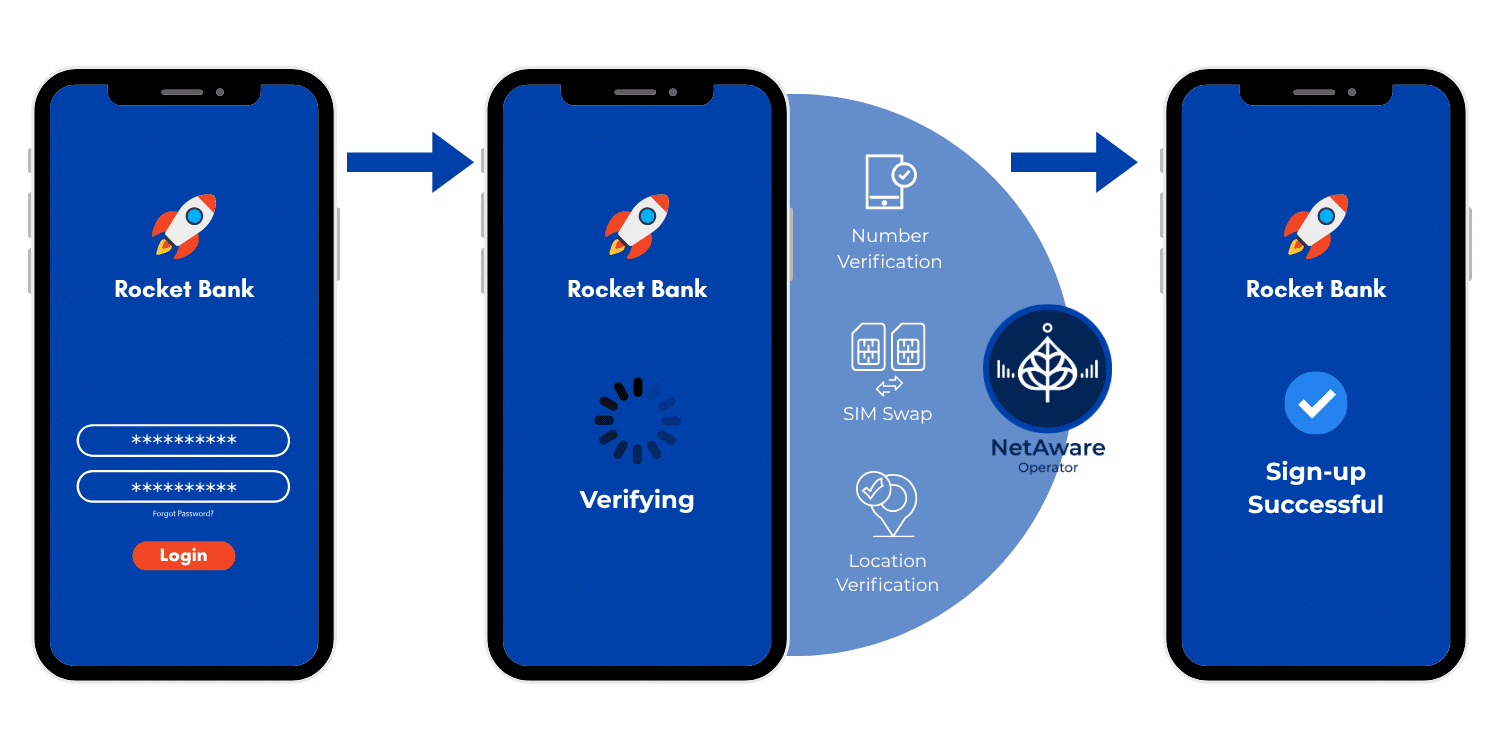
Another important capability is SIM swap detection. The CAMARA Sim Swap API is designed to identify whether a mobile number’s SIM has recently changed, which can be a high-risk signal when used alongside login, password reset, or payment workflows.
For banks and fintech apps that still depend on SMS-based verification, this can add a practical defense against account takeover fraud.
Regulation is also moving the market
Regulators are increasingly treating authentication as a core fraud-prevention requirement, not just a compliance checkbox.
Across multiple markets, the message is clear: financial institutions need stronger, risk-based controls that can withstand phishing, SIM swaps, malware, and account takeover attacks.
In the UAE, the Central Bank’s Notice 2025/3057 requires licensed institutions to phase out SMS and email OTPs and static passwords while strengthening fraud controls.
In India, the Reserve Bank of India’s updated framework for digital payments maintains two-factor authentication requirements while opening the door to more flexible, risk-based approaches beyond traditional SMS OTPs.
In the Philippines, BSP Circular 1213 requires institutions to move away from SMS OTPs for high-risk banking transactions by June 2026, encouraging stronger methods such as biometrics, device-based authentication, and contextual risk analysis.
Taken together, these developments show that regulators are not simply replacing one authentication method with another. They are raising the bar for identity verification, pushing the industry toward layered, phishing-resistant, and risk-aware authentication.
For fintech, that makes flexible identity orchestration and network-aware verification increasingly important as regulations continue to evolve across markets.
What fintech teams should take away
There are three practical conclusions for fintech professionals.
- First, verification should be layered, not replaced one method at a time.
- Second, network-level signals deserve more attention because they can reduce friction while strengthening fraud detection.
- Third, compliance should be treated as a product capability, not just a regulatory burden, because the organizations that adapt early will be better positioned to scale across markets.
Identity verification has always been about trust.
In 2026, the real shift is that trust now depends on orchestration:
- combining multiple signals
- continuously
- and with as little user friction as possible.
The fintech teams that get this right will not just stop more fraud. They will create smoother, safer experiences that customers are more willing to trust.
Want to see how Shabodi NetAware fits into your identity and fraud prevention architecture?
Get in touch with Shabodi.