


Discover how to prevent KYC number recycling fraud using the CAMARA-standardized Number Recycling API and Shabodi NetAware, – a GSMA Open Gateway certified network API integration platform.

Recycled Numbers: A Silent Threat to KYC Integrity
Phone numbers get reassigned all the time — and that creates a quiet but consequential security problem. When an old number is still tied to a user’s account after it’s been handed to someone new, the door is wide open for misdirected SMS messages, weakened account recovery, and real fraud exposure.
For fintechs and telco aggregators running Know Your Customer (KYC) processes, this isn’t a hypothetical edge case. It’s an active blind spot and a direct reason why every identity team needs to understand how to prevent KYC number recycling fraud before it touches their customers or their compliance record.
Studies from Princeton’s Center for Information Technology Policy have shown that tens of millions of phone numbers are disconnected and later reassigned each year, creating fertile ground for account hijacking, misdirected OTPs, and privacy breaches when those numbers remain attached to online accounts.
The scale of this problem is exactly why knowing how to prevent KYC number recycling fraud has moved from a niche concern to a core operational requirement for any organization relying on SMS-based identity verification.
What the Number Recycling API Does, and Why KYC Depends on It
The Number Recycling API (standardized within the CAMARA Open Gateway framework) lets an application ask a very direct question: “Has the subscriber for this phone number changed since this date?”
That single question is central to how to prevent KYC number recycling fraud, because without a reliable answer, your identity verification is only as strong as the last time a user registered their number. In a world of constant number churn, that gap is wider than most compliance teams realize.
By sending a phone number and a specified date to the operator, the API returns a binary answer and in some implementations, a precise timestamp indicating whether the number has been reassigned, without exposing any personal data.
Major operators and aggregators such as Vodafone and Telefónica now expose Number Recycling APIs to help enterprises prevent account lockouts, stop sensitive communications from reaching unintended recipients, and reduce fraud when users change their mobile numbers.
The GSMA Open Gateway initiative is further accelerating this standardization across global networks, making it easier for enterprises to implement number recycling checks at scale.
Why Number Recycling APIs Belong in Every KYC and Digital Verification Journey
If you’re building or operating a KYC pipeline, number recycling is one of the most underestimated fraud vectors you’ll encounter. A legitimate customer onboards, verifies their number, and everything looks clean. Six months later, that same number belongs to a completely different individual and your system has no idea.
Understanding how to prevent KYC number recycling fraud in this scenario isn’t a matter of plugging one hole; it requires a verification layer that continuously confirms number ownership, not just captures a point-in-time snapshot.
Integrating Number Recycling checks into customer workflows gives enterprises a practical, privacy-preserving mechanism to close this gap.
Typical use cases include verifying that a number is still bound to the same subscriber before sending password resets, authorizing high-risk financial transactions, or reactivating dormant accounts. It also helps clean up legacy records where numbers have clearly moved on to new owners a direct step toward data accuracy requirements under GDPR and AML/KYC compliance frameworks.
For regulated industries, knowing how to prevent KYC number recycling fraud is increasingly a compliance question, not just a fraud one.
The result: fewer misdirected messages, measurably lower fraud exposure, and a demonstrably stronger KYC posture — one that regulators, auditors, and customers can trust.
How Shabodi NetAware Makes Number Recycling Truly Scalable Across Operators
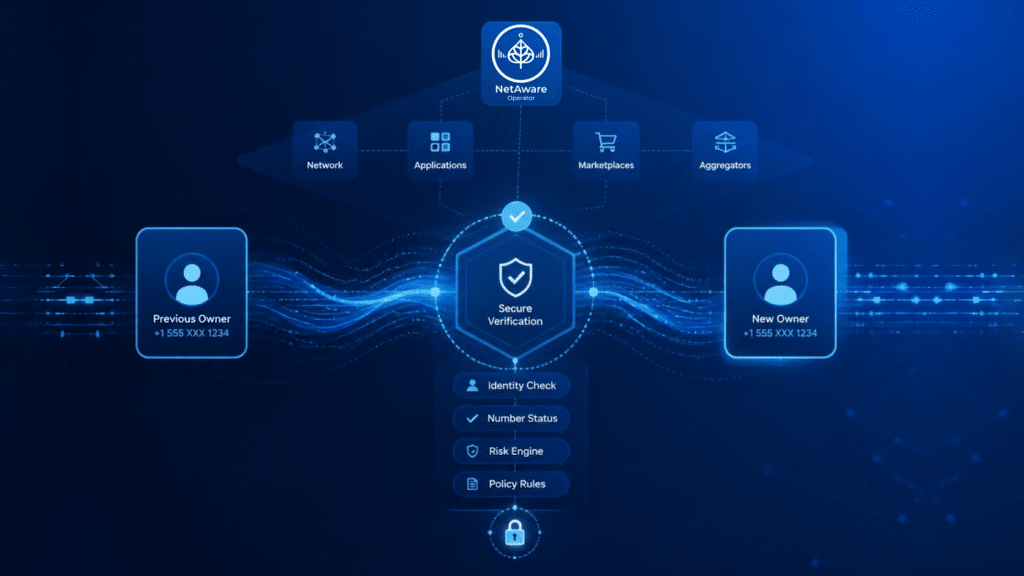
Number Recycling APIs are powerful on their own – but the operational reality for most enterprises is far messier.
Different operators implement slightly different specs. 5G, LTE, and WiFi 6 networks each carry their own nuances.
And if you’re operating across multiple geographies, you’re looking at dozens of individual integrations before you’ve written your first fraud prevention rule. That fragmentation is exactly why many teams struggle to operationalize how to prevent KYC number recycling fraud beyond a single operator or a single market.
Shabodi NetAware Operator Platform resolves this directly.
It’s a GSMA-compliant network API exposure platform that abstracts operator complexity by transforming proprietary network capabilities into standardized, developer-ready APIs.
The NetAware aggregator platform consolidates APIs from multiple operators and exposes them through a single consistent interface – so your engineering team writes one integration, not twenty.
With NetAware, operators and aggregators can expose network APIs including Number Recycling, SIM Swap, and Number Verification as reliable, production-grade services. Developers consume them directly within their applications, without needing deep expertise in each underlying network architecture.
For any team serious about how to prevent KYC number recycling fraud at enterprise scale, this is the infrastructure layer that turns a reactive patch into a proactive, durable control.
A Smarter, Safer KYC Verification Flow – In Practice
Here’s what this looks like in a real-world scenario.
A user attempts to log in or reset their password on a fintech platform. Before the application dispatches an SMS OTP, it calls the Number Recycling API via Shabodi NetAware, passing the user’s phone number and the date it was last verified in the KYC system. The check takes milliseconds. The protection it provides is immediate and measurable.
If the API confirms the number has been recycled, the application automatically triggers step-up verification: an additional identity check, an out-of-band authentication channel, or a prompt for the user to re-enroll their number. Sensitive authentication codes never reach a stranger. Fraud is stopped before it begins. And the experience for legitimate, verified customers remains clean and frictionless.
Because NetAware handles routing, transformation, and metering across multiple operators, this pattern scales cleanly across geographies and network types without forcing developers to master every underlying radio or core network API.
This is how to prevent KYC number recycling fraud not as a one-time patch, but as a repeatable, auditable process embedded directly into your verification architecture.
Why Preventing KYC Number Recycling Fraud Matters More Than Ever
As AI-driven systems and autonomous agents begin interacting with programmable 5G networks and with regulated verticals like banking, healthcare, and mobility – the security assumptions we make about identifiers such as phone numbers must evolve.
The industry is already responding: regulators in multiple markets are tightening KYC obligations, and the cost of a number recycling fraud incident: reputational, regulatory, and financial – is rising sharply. Teams that have not yet addressed this exposure should treat it as a priority, not a roadmap item.
Number Recycling APIs offer a standardized, privacy-preserving way to know precisely when a number has changed hands.
Shabodi NetAware turns that capability into a reusable building block, deployable across your entire application portfolio in a single integration.
For enterprises and operators who are serious about how to prevent KYC number recycling fraud at the infrastructure level, not just the policy level – combining Number Recycling with a network-aware platform is one of the highest-impact investments available right now.
The fraud vectors are evolving. The tools to counter them are here.
The only remaining question is whether your KYC stack is built to use them and whether you’ve made how to prevent KYC number recycling fraud a first-class concern in your identity architecture.
Contact us today to see how Shabodi NetAware can secure your number verification infrastructure.