


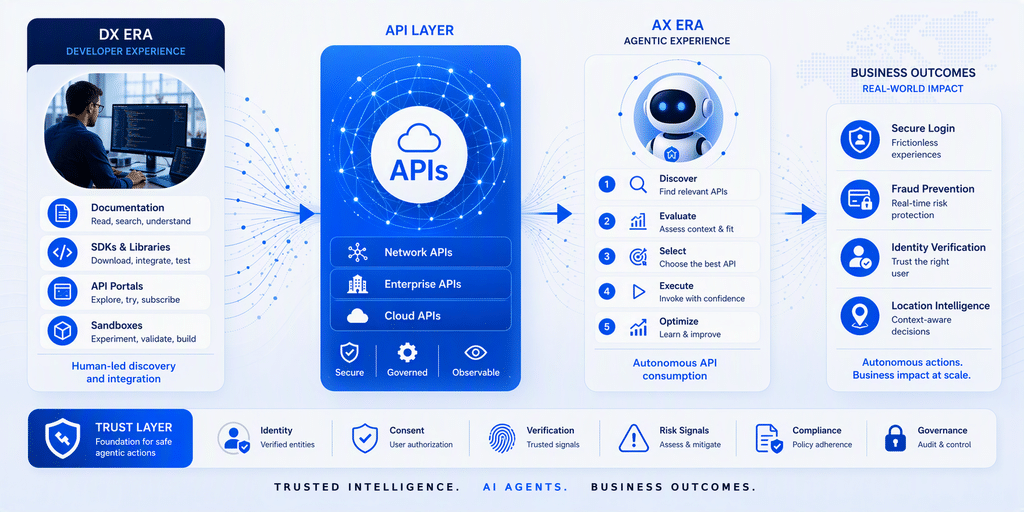
When I think about what made API platforms successful, I come back to how easy they made it to build applications.
Being first, biggest, or best funded wasn’t enough. The API platform companies that stood out made complex infrastructure easier for developers to use. They offered powerful APIs, clear documentation, a quick path to getting started, and tools that kept developers from getting stuck. That is what Developer Experience (DX) meant in practice.
I do not see that work becoming any less important. But I do see the experience these or upcoming API platforms need to deliver beginning to change.
The consumer of APIs is changing
For years, the industry has built API platforms with a human developer in mind. A developer would read the docs, try the examples, work through errors, and carefully write the code to connect everything. The developer was the person the industry was trying to help.
What interests me now is how that customer is changing.
Increasingly, the one making the API call is an AI agent working on someone else’s behalf. It discovers what is available, weighs the trade-offs, and chooses a tool without sitting down to read the documentation. The industry is no longer designing only for developers who browse forums, copy a code snippet, or wait for an answer. The industry is also designing for AI agents that discover, reason, and act at machine speed.
To me, this calls for more than better documentation or cleaner SDKs. It changes who the industry is building the experience for. That is how I think about the move from Developer Experience to Agentic Experience (AX), and why I believe AX will define the next round of platform competition.
That is why Ericsson Research matters to this story. Their 2026 work frames autonomous AI agents as emerging telecom consumers. They also describe AI agents choosing APIs by task fit, cost, compliance, and risk. That adds an important data point to the AX argument.
What changes when the consumer changes
At first, this can look like a small product update. Add an agent wrapper, expose metadata, and call the experience modern. But the bigger change is more structural than that.
Human developers choose APIs from portals, sandboxes, searches, and trusted recommendations. The product goal was simple: help people understand and build faster.
AI Agents choose differently because they optimize for task fit, cost, and constraints. They translate intent into calls and chain tools across workflows. Nobody may review every step before the action happens.
So, the old question no longer goes far enough. It used to be: how fast can someone make the first call? Now it is: how safely can an AI agent act for me? That question demands trust, permission, observability, and clear delegation boundaries.
The invisibility risk
Here is the risk many platform teams are still underestimating. AI Agents do not look where developers look.
A developer may find your API platform capabilities through search, documentation, or a colleague’s suggestion. An AI Agent looks through registries, runtimes, metadata, and learned tool knowledge. If you are absent there, your API becomes effectively invisible.
That invisibility creates three very practical competitive risks.
- Better APIs can lose when less capable ones appear first.
- Early movers compound advantage as AI agents reuse the tools they already know.
- New gatekeepers emerge where discovery, runtime access, and governance converge.
For Network APIs, this means visibility must become a product requirement. APIs need clear schemas, machine-readable context, and agent-ready trust signals. Performance still matters, but discoverability now decides whether agents even arrive.
The window is open now
The window is open because the discovery layer is still being shaped. Registries, runtimes, and agent ecosystems are forming before category habits harden. What once took years of ecosystem adoption may now compress into months.
When I think about the shift from DX to AX, it comes down to this: the last platform era rewarded companies that helped developers work faster. I believe the next one will reward companies that make it safe to trust agents to act on someone’s behalf.
This is the first post in a two-part series on Developer Experience (DX) and Agentic Experience (AX). In part two, “Trust as the New Currency: How NetAware Enables Telecom Network Intelligence Accessible by AI Agents”, we will explore why trust becomes the new currency and explain how Shabodi NetAware is built for that new economic layer.